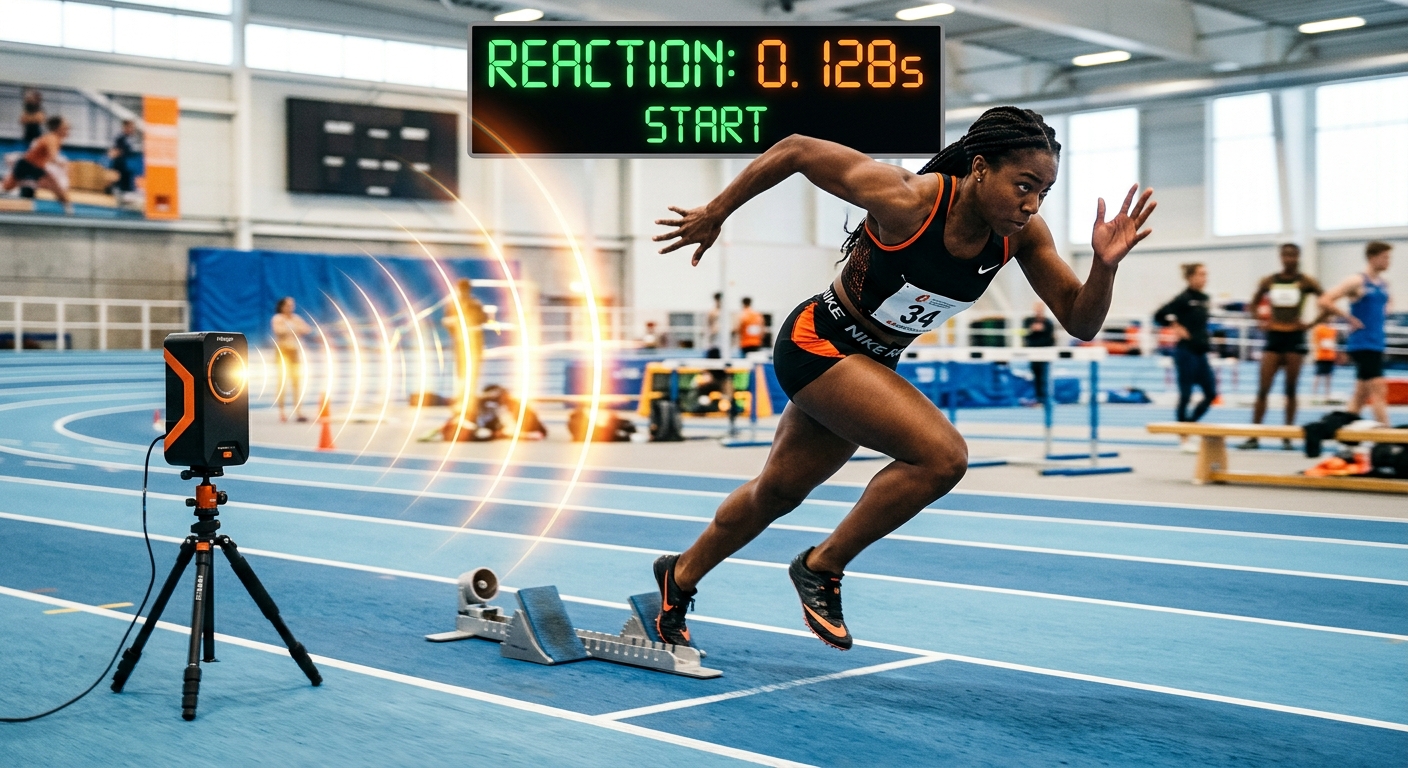
The starting gun fires. A whistle blows. A defensive call rings across the court. Before the body moves, the brain has to hear, process, and fire a signal to the muscles. That gap, from sound to first movement, is audio reaction time, and it is one of the most overlooked edges in competitive sport. Coaches invest hours in strength, agility, and technique. Reaction time to sound almost never gets its own drill block. That is a gap worth closing.
For Coaches Starting This Protocol
- Audio reaction time is distinct from visual reaction time and improves with targeted, consistent drill work.
- A measured baseline before the training block is the only way to confirm whether drills are producing real gains.
- Benchmark scores should shape drill structure, rest periods, and progression, not sit unused in a notebook.
Why Audio Reaction Time Is Its Own Athletic Skill
Most reaction time tools focus on visual cues. A light flashes, a shape appears, the athlete taps a button. That tests one neural pathway. Audio reaction time uses a different one entirely.
Sound enters through the auditory cortex before reaching the motor system. Research in exercise science consistently finds that athletes respond to auditory stimuli along a measurably distinct timeline compared to visual ones. The two pathways have different latency profiles, and they adapt independently. An athlete who drills exclusively off visual cues is leaving the auditory pathway undertrained.
This matters across a wide range of sports. Sprinters react to a gun. Swimmers react to a beep. Basketball players react to a referee's whistle. Linebackers react to a snap count. In every case, the half-second gap between hearing and moving is something training can shrink.
The Neuroscience Behind Trainable Reaction Speed
Reaction time is not a fixed trait written in DNA. The brain adapts when it practices specific responses to specific stimuli. Work documented across decades of simple reaction time research shows that both practice and physical conditioning reduce response latency in measurable ways. Athletes who repeatedly respond to a particular cue type build a more efficient neural pathway for that cue.
That is the mechanism coaches need to understand. Specificity drives adaptation. Training the audio pathway with consistent, randomized cues builds a faster and more reliable response precisely because the nervous system learns to recognize auditory contrast rather than just memorized timing patterns.
Establishing a Baseline Before the Drills Begin
You cannot track improvement without a starting number. This step gets skipped in most practice settings because coaches have no standardized tool to measure audio reaction time in the field. That has changed.
Before the first drill session of a new training block, have each athlete open a browser, put on headphones or sit in a quiet space, and complete a test of audio reaction time. The test delivers a tone at a random interval. The athlete clicks the moment they hear it. The result is a score in milliseconds. Run five trials and average them. That average is the baseline.
Log it by date alongside physical performance data. A single number means nothing in isolation. It becomes actionable when you test again after four to six weeks of structured training and compare the two figures directly.
The Six-Step Drill Protocol for Practice Sessions
This protocol requires a stopwatch and a consistent audio cue. The cue can be a whistle, a hand clap, a starter's beep, or any sharp sound your sport actually uses. Matching the training stimulus to the competition stimulus matters.
- Warm up the nervous system first. Five minutes of light movement before any reaction work. A sluggish nervous system produces artificially slow times. Athletes should have a slightly elevated heart rate before the first rep.
- Place the athlete in competition posture. A sprinter in blocks. A point guard in defensive stance. A swimmer standing on the block. Reaction training transfers best when the body is in the same position it occupies during competition.
- Deliver random-interval cues. Use the stopwatch to vary the gap between the "ready" call and the audio cue. Aim for a range of two to five seconds. Never use a fixed interval. Predictable timing trains anticipation, which bypasses the reaction pathway and gives misleading improvements.
- Time the response. A training partner starts the stopwatch the instant the cue sounds and stops it at the athlete's first visible movement. Log every rep. Eight to twelve reps per set is a solid working range.
- Rest fully between sets. The goal is peak response speed on every rep, not cardiovascular endurance. Keep rest periods at one to two minutes between sets of six reps. Fatigue degrades the data and trains the wrong quality.
- Retest with the browser tool at the end of each training block. Use the same device, the same volume setting, and the same testing environment used at the start. Compare the new average to the original baseline and record the change.
Cue Variety Accelerates Adaptation
A common mistake in this training is using the same sound at every session. When the cue is always the same whistle at a similar volume, the brain starts anticipating it rather than reacting to it. The score improves on paper but the improvement reflects familiarity, not faster processing.
Rotate cues across sessions. Vary pitch, volume, and duration. If your sport uses a horn, a whistle, and a voice command, train with all three in different sessions. The athlete's nervous system learns to respond to auditory contrast. That is the adaptation that shows up on game day, not the one built from drilling a single tone repeatedly.
Reading Benchmark Scores and Adjusting the Training Load
The browser test produces a millisecond average that tells you where an athlete sits relative to common benchmarks. Here is what those numbers mean in practice and what to do with them:
- Above 300 ms: Focus on the fundamentals. Increase cue variety. Confirm the athlete is not anticipating. Check that the testing environment is genuinely quiet with no visual preview of the cue source.
- 200 to 300 ms: Typical range for recreational athletes and untrained adults. Consistent drilling at two to three sessions per week should shift this number within four to six weeks of structured work.
- 150 to 200 ms: Strong range seen in trained athletes in reaction-heavy sports. Introduce decision-based drills at this level. Require the athlete to respond differently depending on pitch or volume, adding cognitive load to the movement chain.
- Plateau across two consecutive testing cycles: Change the cue type entirely. Adjust the random interval range. Introduce a brief physical stressor before the reaction rep to test performance under mild fatigue. Stagnant scores almost always point to stimulus habituation.
Testing Errors That Undermine Your Data
Reliable measurements, from both the browser baseline and the stopwatch drills, require consistent conditions. These are the errors that show up most often and quietly corrupt the numbers.
- Testing while fatigued. Run baseline measurements at the start of practice, not the end. Fatigue suppresses scores and gives a false picture of the athlete's ceiling.
- Using predictable cue timing. Even subtle rhythmic patterns in cue delivery allow the brain to predict the stimulus. Vary the wait time on every single rep without exception.
- Inconsistent device volume. If athletes use different devices or different volume settings between test dates, the results cannot be meaningfully compared. Designate one device at one volume level for the entire training block.
- Variable acoustic environments. Background music, gym noise, or crowd chatter adds cognitive load that depresses scores artificially. Run every browser test in the same acoustic setting each time.
Closing the Loop: From Data Points to Faster Athletes
The value of this protocol is not in any single measurement. It is in the repeating cycle. A coach who tests audio reaction time at the start and end of every training block builds a months-long picture of how the nervous system is adapting. That picture shows which athletes respond to this type of work and which need a different approach, more cue variety, shorter sets, or a change in stimulus type.
It also creates a layer of accountability that abstract training cues cannot match. When an athlete watches their millisecond average drop from 245 to 190 over six weeks of deliberate practice, reaction training stops being an abstract coaching concept and becomes a number they own. Numbers motivate athletes in ways that technique language sometimes cannot.
Start the next training block with a browser-based baseline measurement. Run the six-step protocol two to three times per week. Retest after four to six weeks. Read the numbers and adjust the drill structure based on where each athlete lands. Then run the block again. That cycle, repeated across a full season, is where the competitive edge between athletes of similar physical ability actually gets built.